

Extending The Eviction Moratorium and More: New Changes In Commercial Eviction Procedures in New York
Effective September 2, 2021, a new law extended New York’s moratorium on commercial and residential evictions to January 15, 2022, while also enacting several other significant measures of which all commercial landlords and managing agents should be aware.
Read MoreEmployers’ Obligation to Implement Their Exposure Prevention Plans Triggered by Formal Designation of COVID-19 as a “Highly Contagious Communicable Disease” under NY’s HERO ACT
On September 6, 2021, New York Governor Kathy Hochul announced that the NYS Department of Health has designated COVID-19 as a “highly contagious communicable disease that presents a serious risk of harm to the public health” under New York’s HERO Act. This formal designation has immediate significance for all New York employers.
Read More
Harrington & Rodriguez Secure Dismissal of Defamation Case
Chairman William P. Harrington and Partner Adam Rodriguez recently secured a complete victory in a defamation case among rival cell phone companies.
The plaintiff, Red Pocket Inc., alleged that our clients US Mobile and its founder/CEO made defamatory comments about Red Pocket on a mobile phone services podcast, and sought $2.5 million in damages.
We filed a motion to dismiss, arguing that the Complaint should be dismissed because Red Pocket failed to plead a statement that is defamatory on its face. In addition, we argued that the Complaint was barred under New York’s single instance rule. Under the rule, language charging a plaintiff with ignorance or mistake on a single occasion only, and not accusing general incompetence, or lack of basic integrity or creditworthiness, cannot be considered defamatory on its face and so is not actionable unless special damages are pleaded.
In a thorough decision, Judge Linda S. Jamieson of the N.Y. Supreme Court Commercial division agreed with our arguments, and dismissed the complaint filed against our clients in its entirety.
Mr. Harrington
Mr. Harrington is Chairman of the Firm’s Executive Committee. He is the head of the Litigation and Toxic Tort/Complex Litigation Practice Groups. Mr. Harrington is an experienced trial attorney who has represented Fortune 500 companies in criminal, commercial, environmental, civil rights, real estate, gaming and employment discrimination matters. His clients have included major oil companies, pharmaceutical companies, hospitals, racetracks/casinos, financial institutions and significant regional companies in all aspects of complex environmental, toxic tort and commercial litigation. Mr. Harrington also represents both municipalities and developers in all phases of land use development and related litigation.
To read Mr. Harington’s attorney profile, click here.
Mr. Rodriguez
Mr. Rodriguez focuses his practice in the areas of commercial litigation, municipal law, intellectual property and real estate. He currently serves as the Yorktown Town Attorney, acting as legal counsel to the Town, its elected officials, department heads, and its various boards. Before joining Bleakley Platt, Mr. Rodriguez was the Director of Real Estate for Westchester County, where he negotiated complex commercial real estate transactions valued at over $100 million. Prior to his appointment as Director of Real Estate, Mr. Rodriguez defended the County of Westchester in one of the highest-profile HUD enforcement actions in United States history. He has also served as a law clerk to two federal judges, and worked as a litigator at a large law firm in New York City.
To read Mr. Rodriguez’s attorney profile, click here.
Read MoreNew York’s Construction Industry Wage Theft Bill: Prime Contractors in New York Now Liable for Unpaid Wages Owed To Subcontractors’ Employees
On September 6, 2021, NY Governor Hochul signed into law the Construction Industry Wage Theft bill (S2766C), imposing joint and several liability on prime contractors for the wage and benefit claims of their subcontractors’ employees. Effective January 4, 2022, the new law covers claims for unpaid wages, benefits and wage supplements as defined by NY Labor Law § 198, and thus covers not only wages but also reimbursable expenses, health and retirement benefits, and vacation, separation and holiday pay.
The law also incorporates and applies to prime contractors all other remedies available to employees under NYLL § 198, including liability for an additional amount, up to 100% of the unpaid wages, as liquidated damages (and up to 300% where a willful violation is shown); attorneys’ fees; prejudgment interest; and other potential penalties. It bears noting that contractors may contract for indemnification by subcontractors and may maintain an action against a subcontractor to recover owed wages that are paid by the contractor. The law applies to all non-union contracts and employees.
The obligations imposed by this new law may already exist for those general contractors who are deemed to be a “joint employer” under applicable federal and NYS wage and hour laws. However it effectively expands “joint employer” liability to include employers beyond those currently recognized under these wage and hour laws, and provides remedies which may not in any event be available under federal law.
In light of the risks of liability created by this new law, prime contractors in New York would be well advised to develop strong indemnification provisions for their subcontracts, as well as auditing and other contract management practices to ensure that their subcontractors’ non-union employees are receiving all wages and benefits to which they are entitled.
Bleakley Platt’s employment and construction law attorneys are continuously monitoring legal developments relevant to their clients’ interests. If you have any questions regarding this alert, please contact Joseph DeGiuseppe at jdegiuseppe@bpslaw.com | 914-287-6144, or Jonathan Murphy at jamurphy@bpslaw.com | 914-287-6165.
Read MoreEmergency Regulation on Mandatory Vaccinations for Health Facility Workers
The Public Health and Health Planning Council and the Commissioner of Health approved emergency regulations on August 26, 2021 to help combat the increasing circulation of the SARS-CoV-2 Delta variant. When filed, the new regulations will supersede the order announced August 16 by Governor Andrew M. Cuomo for hospital and nursing home workers, but without any religious exemption from the vaccination requirement.
Read MoreTrademark Modernization Act Signed Into Law for Federal Trademark Owners in New York and Beyond
The United States Patent and Trademark Office signed the Trademark Modernization Act (“TMA”) into law last year, prompting future changes for federal trademark owners in New York state and nationally. The Act will formally be implemented on December 27th, 2021. Although the TMA offers trademark owners additional tools, it also expands trademark cancellation mechanisms that might cause some trademark holders to lose their federal trademark.
Read MoreHow Biden’s Executive Order Could Impact Healthcare Law in New York
On July 9th President Biden signed an expansive executive order aimed at promoting competition in the American economy, prompting possible changes to healthcare laws in New York. This order established 72 initiatives involving more than a dozen federal agencies to tackle some of the most pressing competition problems in the US economy, with a specific focus on medical and pharmaceutical companies.
Read MoreNew York’s Marijuana Legalization from the Perspective of DWI Attorneys
With Governor Cuomo recently signing the Marijuana Regulation and Taxation Act into law, many legal professionals speculate whether New York will see an increase in impaired driving arrests following the legalization of recreational marijuana. Although possession of a small amount of marijuana for recreational use in now legal, a person can still face criminal prosecution for operating a motor vehicle while his or her ability to do so is impaired by the use of marijuana pursuant to New York’s Driving While Ability Impaired by Drugs (DWAI Drugs) statute. The team of attorneys at Bleakley Platt & Schmidt is experienced in defending clients charged with driving under the influence of alcohol or drugs (such as marijuana). Please read below for the possible charges a person could face in New York for driving a car after consuming alcohol or drugs.
Read MoreNY HERO ACT INFECTIOUS DISEASE PREVENTION PLANS: WHAT ALL PRIVATE EMPLOYERS NEED TO KNOW
The New York Health and Essential Rights Act (HERO Act) was signed into law by Governor Andrew Cuomo on May 5, 2021. The HERO Act added two new sections to the New York Labor Law: Section 218-b, requiring all private employers to adopt airborne infectious disease prevention plans and standards; and Section 27-D, requiring private employers with 10 or more employees to allow the creation and administration of joint labor-management workforce safety committees. Governor Cuomo approved clarifying amendments (the Amendments) to the HERO Act on June 14, 2021. The HERO Act and its Amendments impose significant workplace health and safety obligations on New York employers.
Read MoreSpecial Needs Planning and Guardianship for Persons with Intellectual and Developmental Disabilities
Wednesday, July 21st
10:00 – 11:00
Register for this FREE webinar for Seniors & their Families
Registration URL http://bit.ly/WestSpecialNeeds
(Dial-in by phone also available; numbers obtained on registration or by calling and leaving a message for Paul at 914.231.3227)
Are you the parent or grandparent of a child with an intellectual or developmental disability such as autism? This workshop will provide an overview of the legal and financial steps to access critical supports and government benefits. Topics covered will include guardianship proceedings in Surrogate’s Court, government benefits for individuals with disabilities and the estate planning that must be done to protect an inheritance or lawsuit settlement for people with disabilities.
Planning is empowerment. Learn about the steps that will provide you with peace of mind that you have done everything in your power to secure for your loved one’s future needs.
Speaker: Frances M. Pantaleo, Esq., Bleakley Platt & Schmidt, LLP Limited to first 100 participantsContact: bruce@marketingsense2.com
Click here to view/download the PDF with the information for this event.
Read MoreBleakley Platt & Schmidt, LLP Pleased to Announce the Hiring of Two Associates
WHITE PLAINS, NY—Bleakley Platt & Schmidt is happy to announce that Kadeen Wong, Esq. and Gina Nicotera, Esq. have joined the Firm as associates. Kadeen Wong is part of the Firm’s Elder Law and Special Needs Practice Group as well as its Trusts and Estates Practice Group. Gina Nicotera is a member of the Firm’s Labor and Employment Practice Group.
Prior to joining the Firm, Kadeen Wong worked in law firms located in White Plains and New York City. She earned her law degree from Elisabeth Huab School of Law at Pace University and is admitted to practice law in both New York and New Jersey. Her accomplishments include various publications and a wealth of speaking engagements in her field of expertise. She is also rated a Super Lawyers Rising Star.
Gina Nicotera worked in law firms located in New York City and White Plains, where she focused her practice in employment litigation and counseling. Gina earned her law degree from Pace University School of Law and is admitted to practice in New York, New Jersey, U.S. District Courts for the Southern, Eastern and Western Districts of New York and U.S. Court of Appeals for the Second Circuit. She is a member of several professional organizations, including the Federal Bar Council: Section on Labor and Employment, New York State Bar Association: Section on Labor and Employment, Columbian Lawyer’s Association and Young Professionals Business Network. Nicotera is also a member of the non-profit America Needs You: New York Associate Board, an organization that fights for economic mobility for first-generation college students.
Gina and Kadeen have outstanding professional backgrounds, which advance the Firm’s growth trajectory in the Westchester County business community.
Bleakley Platt & Schmidt, LLP
Bleakley Platt & Schmidt, LLP is Westchester’s preeminent law firm, with a more than 85-year legacy of providing superior legal counsel to residents and businesses of Westchester and Rockland Counties, as well as the entire Hudson Valley and Fairfield County, CT. To learn more about the Firm’s services, visit www.bpslaw.com, or contact its offices at (914) 949-2700.
Read MoreOSHA Issues Emergency Temporary Standard for Healthcare Employers
On June 21, 2021, the Occupational Safety and Health Administration (OSHA) adopted its COVID-19 Healthcare Emergency Temporary Standard (ETS). Employers providing health care services will be required to comply with new COVID-19 specific standards to protect their workforces. The ETS focuses on protections for unvaccinated or otherwise “at-risk” workers, who are described as those that “cannot be protected through vaccination, cannot get vaccinated, or cannot use face coverings.” The ETS encourages vaccination by requiring employers to provide reasonable time and paid leave for employees to receive vaccinations and recovery from any side effects.
Read MoreLegalization of Cannabis: What This Means for Employment Law in New York
Several years after legislation was first introduced, New York Governor Andrew Cuomo signed the Marijuana Regulation and Taxation Act into law on March 31st, 2021, making New York the state to have most recently legalized recreational marijuana use by individuals who are at least 21 years old. This act has been several years in the making, with medical cannabis use having been legalized in 2014 and minor marijuana related offences having been decriminalized in 2019. The Marijuana Regulation and Taxation Act goes into effect immediately, raising crucial questions about its implications for employment law in New York.
Read MoreHow Our Litigation Attorneys Serve the Greater New York Area
Since 1937, Bleakley Platt & Schmidt has provided our clients and the community quality legal services. We represent clients from New York City through the Hudson Valley and beyond, leveraging decades of experience to achieve first-rate results.
Our years of experience and success speak for themselves, particularly in litigation practice for both local and national businesses. Our litigation practice areas include commercial litigation, construction, environmental, personal injury, product liability, toxic tort, and more. We also provide counsel on litigation avoidance as well as pre-litigation advice. We have supervised and managed a wide array of complex cases and can call upon other practice groups in our organization for their expertise.
Read MoreBleakley Platt & Schmidt Partner Frances Pantaleo to Talk on Special Needs Planning
Bleakley Platt & Schmidt is proud to announce that partner Frances Pantaleo will give a presentation on special needs planning this Tuesday, April 27th at noon. The program will be hosted by Women in Wealth of Stamford and can be accessed by Zoom Meeting ID: 982 0435 4472 or joined by Phone: US: 929-436-2866.
Women in Wealth of Stamford is a group of Morgan Stanley female financial advisors who have come together to help other women achieve their financial goals through education and engagement. Frances Pantaleo, as head of Bleakley Platt & Schmidt’s Elder Law and Special Needs Practice Group, will be providing a wealth of education on special needs planning that can benefit both children and adults with special needs. Pantaleo is a former law professor and former Chair of the Elder Law and Special Needs Section of the New York State Bar Association. She handles a broad range of estate planning with a special emphasis on Medicaid planning, supplemental needs trusts, and guardianship proceedings.
Read MoreBleakley Platt & Schmidt Advances SUEZ Water New York to Site Development Plan Review
Bleakley Platt & Schmidt’s Lino Sciaretta represents SUEZ Water New York Inc. (SWNY) as land use counsel in connection with the relocation of its headquarters from 360 West Nyack Road, West Nyack, NY to 162 Old Mill Road in Rockland County. SWNY currently occupies 162 Old Mill Road as its operations center. The operations center houses construction, administration, management, and customer support staff. Further, the site accommodates customers and developers seeking to pay their bills, apply for service, or modify water services. Additional construction employees and materials are located at 360 West Nyack Road. SWNY is advancing this operations consolidation project to allow for greater efficiency in its daily operations by improving and optimizing the operations center to house all employees, vehicles, and standard infrastructure materials (piping, hydrants, valves, etc.) at the 162 Old Mill site. Sciaretta has appeared before the Town of Clarkstown Technical Advisory Committee and received approval to proceed to the Planning Board for site development plan review. To read Rockland County Business Journal’s full story on this project, click here.
Read MoreCommercial Finance Law and New York’s Truth in Lending Act
In July 2020, the State of New York passed the Truth in Lending Act, designed to improve transparency in borrowing costs. The bill requires clearer language from lenders so that businesses can more easily compare financing offers. According to the Responsible Business Lending Coalition, the bill requires all lenders to disclose annual percentage rate and repayment terms for loans. This law has important ramifications for lenders and has triggered further changes to State law regarding commercial finance.
Read MoreVincent Crowe Wins Appeal on Behalf of Commodore Maintenance Corp.
On February 4, 2021, Vincent W. Crowe prevailed on appeal following the lower Court’s denial of Summary Judgment to the firm’s longstanding client, Commodore Maintenance Corp. See Pastorino v. New York City, Commodore Maintenance, 2021 N.Y. Slip Op. 00634 (App. Div. 1st Dept.). In Pastorino, plaintiff, a dock builder working on the Broadway Bridge connecting Manhattan and the Bronx was injured while climbing from a tug onto a barge. Plaintiff asserted a Longshore and Harbor Workers’ Compensation Act (LHWCA) claim against Commodore and Labor Law claims against the City of New York.
The Appellate Division reversed the Supreme Court, New York County Decision and determined that Commodore Maintenance Corp. was not liable to plaintiff under the LHWCA (33 U.S.C. §905) as it did not qualify as a “bareboat” charterer. The Court determined that the charter agreement between Commodore and third-party defendant Ocean Marine did not provide for the complete and exclusive relinquishment of possession and control to Commodore of the tug involved in plaintiff’s accident. In addition, all crossclaims against the City of New York were dismissed under the “anti-subrogation” rule and third-party defendant Ocean Marine’s counterclaims were dismissed.
Read MoreDiaconis and Rodriguez Successfully Defend Summary Judgment Attack – Paving Way for Multi Million Dollar Recovery, Including Attorneys Fees for Prosecution of Action
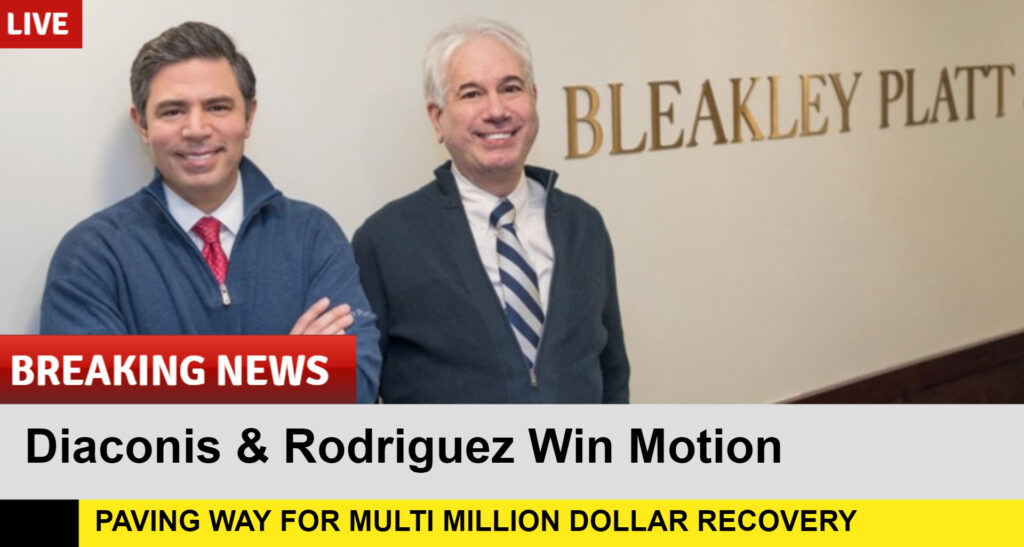
Partners John Diaconis and Adam Rodriguez successfully defended a summary judgment decision they procured on behalf of Westchester County against Unity Mechanical Corp., in a defense and indemnity case brought in Westchester County Supreme Court.
The lawsuit arose out of injuries sustained by a Unity employee on May 30, 2013. The Unity employee was injured while performing work in the Westchester County Courthouse under a boiler repair contract with the County. The employee was standing on an A-frame ladder and fell to the floor, causing him to sustain significant injuries.
Unity agreed in the boiler repair contract with the County to defend and indemnify the County for “all” liability arising out of the performance under the Contract.
However, after the Unity employee sued the County in 2013, Unity refused to honor its contractual commitments to defend the County in the underlying action. So, the County defended itself. Years later, after a finding of “strict” liability against the County under the N.Y. Labor Law.
Unity ignored the County’s repeated offers to participate in settlement discussions, and the underlying action ultimately settled for $2.875 million. Unity then refused to indemnify the County for the settlement amount, so the County initiated a lawsuit.
The Court granted the County’s motion for summary judgment and held that Unity breached its duties to defend and indemnify the County. The Court also held that the County was entitled to attorneys’ fees for defending the underlying action, as well as the action-in-chief to recover the settlement proceeds.
Unity moved for reargument, arguing that the Court: (1) misapprehended the scope of Unity’s duty to defend and indemnify the County; (2) failed to address whether the County’s alleged negligence should preclude contractual indemnification to the County; and (3) failed to address the County’s alleged spoliation of evidence.
On December 31, 2020, in a thorough decision, the Court rejected Unity’s arguments and sustained its prior holdings, paving the way to a potential recovery of over $3 million for the County.
Here is a link to the decision.
Read MorePartner Robert Meade Secures Litigation Win for William Penn Life Insurance Company

Our Partner, Robert D. Meade, secured a litigation win on appeal of a case he argued at trial for the firm’s long-standing client William Penn Life Insurance Company of New York. See, Bonem v. William Penn Life Ins. Co. of N.Y., 2021 NY Slip Op 00227 (App. Div. 1st Dept.) The Appellate Division, First Department vacated the judgment of the Supreme Court, New York County (Justice Arthur F. Engoron) entered on August 17, 2020 which had awarded plaintiff $1 million on a life insurance policy. The lower court decision was unanimously overturned, with the Appellate Division directing the Clerk to enter judgment for William Penn, finding that the plaintiff was not entitled to coverage under the subject insurance policy because it had lapsed before the insured’s death.
Read MoreHow Biden’s Labor Department Pick Could Affect Construction Law in New York
Amidst many changes in the transition from a Trump to Biden presidency, one that stands out in particular is the nomination of Boston Mayor Marty Walsh as labor secretary. Mayor Walsh, a former leader of the Boston Building and Construction Trades Council and former head of the Laborer’s Union, boasts widespread union support and mirrors Biden’s agenda for a worker-friendly labor department. This nomination could have widespread impact on current construction law standards for New York builders.
Read More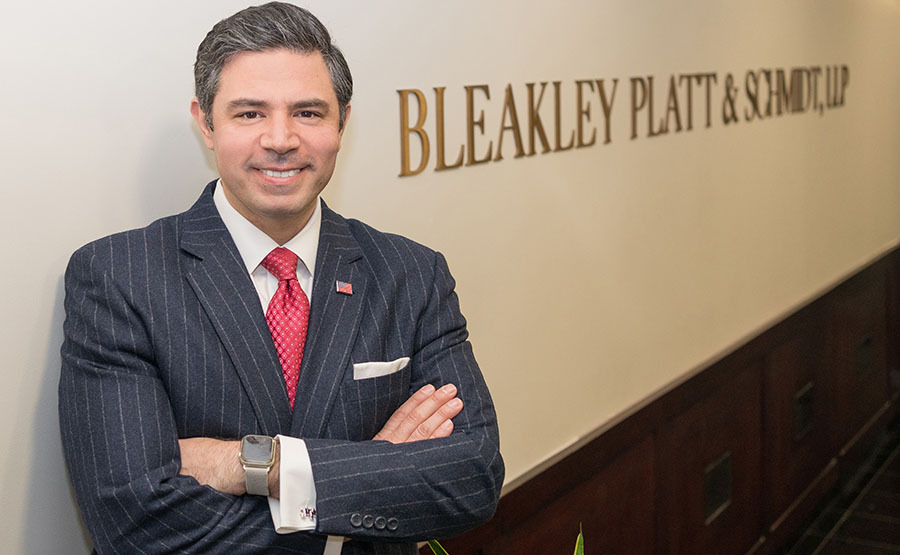
Bleakley Platt & Schmidt, LLP Announces Adam Rodriguez as Partner
Mr. Rodriguez, a native of Yonkers, focuses his practice in the areas of commercial litigation, municipal law, intellectual property and real estate. He currently serves as the Yorktown Town Attorney, acting as legal counsel to the Town, its elected officials, department heads, and its various boards. He is also a Director of Lifting Up Westchester, a non-profit that helps Westchester residents overcome the challenges of poverty, homelessness, hunger, health and education, and Friends of Miller House/Washington’s Headquarters, a non-profit committed to sustaining the legacy of George Washington.
Read MoreBleakley Platt & Schmidt Continues Its Proud Support of the Children’s Health & Research Foundation
Bleakley Platt & Schmidt is proud to support the Children’s Health & Research Foundation (CHRF). Through financial, legal, administrative and other support, as well as board service, the Firm assists CHRF in realizing its mission to promote the health of children and families in New York’s Hudson Valley and surrounding regions.
Read MoreFriends of Miller House/Washington’s Headquarters Announces New Leadership
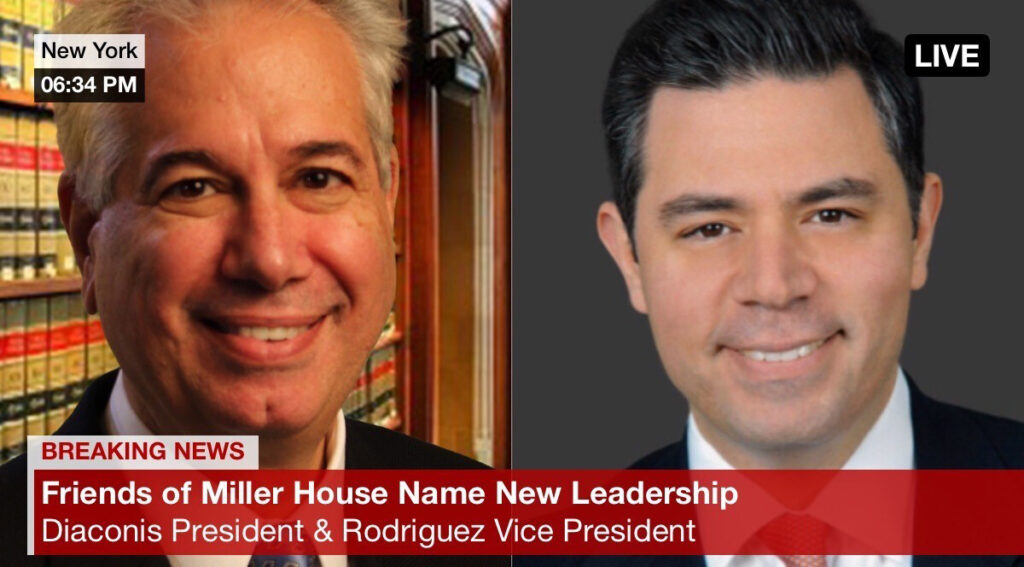
White Plains, NY: Today, Friends of Miller House/Washington’s Headquarters announced that new leadership has been elected for the term commencing on January 1, 2021.
Former New Castle Town Board member and long-time advocate for Miller House, John S. Diaconis has been elected President. Adam Rodriguez has been elected Vice President. Mr. Diaconis and Mr. Rodriguez are partners in the law firm of Bleakley, Platt & Schmidt LLP. One of Westchester’s oldest firms, Bleakley Platt has a history of civic engagement in Westchester County. The founding member was William Bleakley, Westchester’s first County Executive.
Edward L. Woodyard was elected Vice President as well. Mr. Woodyard has been involved with the Friends since its inception, and he is active in community affairs. Mr. Woodyard is a former President of the organization. Leo Vircillo will be the new Treasurer.
Linda Fernburg has stepped down as President, but will remain on the board of directors. The Friends are appreciative of Linda’s past service and pleased she’ll stay on as board member.
Mr. Diaconis said: “We are grateful for County Executive Latimer’s leadership in preserving this historic landmark. The Elijah Miller House is an 18th century farm house used by General George Washington during the Revolutionary War as a headquarters command post. The house was home to Ann and Elijah Miller and their 7 children. Elijah Miller and two sons John and Elijah, Jr. all died as members of Westchester’s militia in 1776. A woman of great courage, Ann Miller then turned the house into a hospital for Continental soldiers. During the Battle of White Plains, soldiers took shelter under the shade of a 300 year old sycamore that’s preserved on the property.”
Mr. Rodriguez added: “George Washington’s leadership during and after the American Revolution set this great nation on a path that has endured for over two hundred years. The Friends are committed to sustaining Washington’s legacy. We’ll assist the County in programming and plan to educate citizens both young and old not only about Washington’s unprecedented achievements, but also his position and struggle with other controversial issues.”
Mr. Diaconis and Mr. Rodriguez both thanked Daughters of Liberty’s Legacy for their hard work in preserving the house.
The Friends are looking to fill board of director vacancies and for members. Those interested may contact Mr. Diaconis directly at jdiaconis@bpslaw.com.
Read MorePotential Landlord Liability For Tenant-on Tenant Harassment Under Federal Fair Housing Act Is Clarified
A potentially large legal development occurred last week when the US Court of Appeals for the Second Circuit (a federal appeals court which covers NY, CT and VT), held that, under some narrow circumstances, a landlord will not be held liable under the federal Fair Housing Act (“FHA”) for a tenant’s harassment of another tenant when the tenant being harassed is a member of a protected class.
A quick summary of the facts in Francis v. King’s Park Manor, Inc. is in order. An African-American tenant (Francis) was subjected to race-based harassment by his neighbor (Endres). Francis sought police intervention, which ultimately resulted in prosecution Endres’ prosecution for aggravated harassment, Endres voluntarily vacating his apartment and pleading guilty to harassment. According to the opinion, Francis renewed his lease without objection and never sought intervention by the landlord or its managing agent.
Francis later sued the landlord claiming that the landlord’s failure to prevent tenant on tenant harassment constituted a violation of the FHA. Francis also sued for breach of contract (his lease) and intentional infliction of emotional distress. In the litigation history, the federal District Court (a trial level court) dismissed the discrimination and emotional distress claims. Francis appealed to the Second Circuit, which initially reversed the lower court and reinstated Francis’ claims. The landlord requested that the entire panel of Circuit Court Judges hear the appeal (a process known as “en banc”). Although an en banc appeal request is rarely granted, in this case the entire Second Circuit agreed to decide the case en banc.
In a bitterly divided set of opinions (a 7 Judge majority opinion and a 5 Judge dissenting opinion), the majority of the Second Circuit agreed with the District Court that Francis had not “plausibly alleged” violations of the FHA or intentional infliction of emotional distress. But in a minimally disguised warning to landlords, owners and managers of residential properties, the Second Circuit majority held:
We assume, for purposes of this appeal, that deliberate indifference may be used to establish liability under the FHA when a plaintiff plausibly alleges that the defendant exercised substantial control over the context in which the harassment occurs and over the harasser. Nevertheless, we hold that Francis has failed to state a claim because his Complaint provides no factual basis to infer that the KPM Defendants had “substantial control over [Endres] and the context in which the known harassment occur[red].” Nor can such control be reasonably presumed to exist in the typically arms-length relationship between landlord and tenant, unlike the custodial environments of schools and prisons. The typical powers of a landlord over a tenant—such as the power to evict—do not establish the substantial control necessary to state a deliberate indifference claim under the FHA.
Francis v. Kings Park Manor, Inc., No. 15-1823-cv, 2021 U.S. App. LEXIS 8761, at *10-11 (2d Cir. Mar. 25, 2021)
Thus, a majority of the Second Circuit ruled that when a landlord or property owner/manager exercised “substantial control over the context in which the harassment occurs and over the harasser” liability under the FHA can be both plausibly alleged and ultimately proved in Court.
This opinion is generally consistent with our firm’s advice over the years that landlords, property owners and managers are well advised, upon learning of tenant-on-tenant harassment, whether based upon one party’s race, disability or even on no apparent basis at all, to take affirmative steps to attempt to defuse the hostility and counsel the warring factions to take affirmative steps to avoid further confrontation. Mediation is oftentimes advisable.
The five Judge dissenting opinion believed Francis “plausibly alleged” discrimination by alleging that the owners of the management company told its property manager “not to get involved” in the tenant-on-tenant harassment and argued for a much broader reading of the FHA to apply to conduct similar to that alleged here.
The decision in Francis v. King’s Park Manor, Inc. substantially conflicts with a decision by the Seventh Circuit Court of Appeals (in the Midwest) which found the tenant being harassed had plausibly alleged a violation of the FHA. Because there exists a conflict of opinions between two Circuit Courts of Appeal, it is possible for the Supreme Court to become involved.
At Bleakley Platt & Schmidt, we continue to advise our landlord, property owner and property manager clients to intervene to prevent disputes from escalating into allegations of harassment and discrimination. Failure to intervene may result in legal liability and a charge of discrimination.
Bleakley Platt & Schmidt will continue to provide guidance to its landlord and tenant clients as laws and case law continue to evolve on the federal, state and local levels.
Read MoreLandlord-Tenant/Co-op Issues New Required Notice To Tenants
New York State has mandated that owners of residential rental properties must notify residential tenants of the tenants’ right to request (a) reasonable accommodations of rules, policies, practices, procedures and services and (b) reasonable modifications to their apartments or common areas, when such reasonable accommodations or reasonable modifications are necessary to allow a person with disabilities to experience the same use and enjoyment of their premises as a person without disabilities.
The new law, which amends Section 296 of the New York Executive Law to add a new subsection 18-a, took effect on March 2, 2021. Highlights of this new law are:
- Section 18-a applies to “every owner, lessee, sub-lessee, assignee, or managing agent of, or other person having the right of ownership of or possession of or the right to rent or lease housing accommodations.”
- Section 18-a requires notice to all current and prospective tenants of their right to request reasonable accommodations or reasonable modifications if they are a person with a disability.
- The notice must be in writing and given in such form and in such manner at the NY State Division of Human Rights (“DHR”) may proscribe.
- Notice must be given to all current tenants on or before April 1, 2021.
- The notice must be conspicuously posted on or in all vacant residential premises.
The DHR website contains a sample notice. The sample notice includes numerous possible reasonable accommodations or reasonable modifications which a tenant with a disability may request. Owners, landlords and managing agents of residential rental properties should be aware, however, that the examples contained in the sample notice are for illustrative purposes only, and are by no means an exclusive list of reasonable accommodations or reasonable modifications which a residential tenant may request and to which a property owner or landlord may be required to respond.
The DHR sample notice also educates a tenant on how to file a complaint with DHR if the tenant’s reasonable accommodation or reasonable modification request is denied or a decision is unduly delayed.
Since Section 296 (18-a) provides that that “such disclosure shall be made in writing in such form and manner as the division by regulation shall prescribe,” landlords and property owners are free to prepare their own notices, but we advise them to use the sample notice on the DHR website as a guide and not to deviate too far from the sample notice in content.
Landlords and property owners should keep several important concepts in mind. First, the requirement to reasonably accommodate tenants with disabilities is not new, and has existed in some form since the 1970s. Only the notice to tenants of the right to request reasonable accommodations and reasonable modifications is new.
Second, the notice must be handled in tandem with the underlying legal obligation to reasonably accommodate disabilities. Requests for reasonable accommodations or reasonable modifications must undergo an “interactive process” by which the property owner or landlord and the tenant attempt to analyze ways to address the issues raised by tenants with a disability.
The “interactive process” and the legal standard for property owners or landlords to reasonably accommodate a tenant’s request are beyond the scope of this article. Generally, however, whether to accommodate a request by a tenant with a disability requires a balance between (i) the reasonable and justifiable nature of the tenant’s request and (ii) the hardship the request may cause to the property owner or landlord. If the request is medically, emotionally or psychologically justified and would not cause “undue financial or administrative burdens” to the property owner or landlord, the request is deemed reasonable and should be granted. If, however, the request involves a significant financial cost to the landlord or a fundamental change in the nature of the landlord’s business, a refusal to accommodate a tenant’s request may be justified.
Bleakley Platt & Schmidt will continue to provide guidance to its landlord and tenant clients as laws continue to evolve on the federal, state and local levels.
Read MoreNew York’s Infrastructure Investments Spotlight Importance of Environmental Law
In the next few years, infrastructure and construction are expected to be among the most promising sectors contributing to post-pandemic economic recovery. Their prominent role is due, at least in part, to the $275 billion funding plan introduced by Governor Andrew Cuomo in February 2020. In order for these projects to receive funding and approval to begin, however, they will have to comply with environmental laws and regulations.
Read MoreBrian Quinn and Lino Sciarretta Join Bleakley Platt & Schmidt, LLP to Open Rockland County Office
WHITE PLAINS, NY – Bleakley Platt & Schmidt, LLP is pleased to announce the addition of two new partners, Brian Quinn and Lino Sciarretta, former members of Montalbano Condon & Frank, PC., which maintains its office in New City, NY and will continue its legal practice. Mr. Quinn practices in the areas of banking, real estate, and land use law, while Mr. Sciarretta practices real estate and land use law. Their joining the Firm greatly strengthens Bleakley Platt & Schmidt’s Land Use & Zoning practice. They are also spearheading the opening of a Rockland County office.
Mr. Quinn worked for Manhattan law firms for over a decade before relocating to Rockland County, where he has practiced law for more than thirty years. In that time, he has represented commercial lending institutions in complex commercial mortgages, construction loans, asset based lending, and creative financing. He has prosecuted numerous commercial foreclosures and has represented commercial lenders in preserving and enforcing creditors’ interests after debtors have filed for bankruptcy.
Mr. Quinn has also prosecuted and defended various types of real estate litigation on behalf of title companies, individuals, and corporate entities involving Article 15 bar claim actions, tax foreclosures, easements, adverse possession claims, and boundary line disputes.
Thoroughly familiar with local and state zoning practices, procedures and environmental law, Mr. Quinn has represented many of Rockland County’s major companies and developers on land use and zoning matters.
In his twenty-three years practicing law, Mr. Sciarretta has held the positions of Town Attorney for the Town of Clarkstown, NY and Village Attorney in several municipalities. He has considerable commercial litigation and transaction experience and has represented governmental agencies, developers, municipalities, and private sector clients in zoning, real estate development, civil rights, discrimination in employment, and environmental matters.
Additionally, Mr. Sciarretta has a wide range of experience in real estate transactions, encompassing commercial mortgages, construction loans, sales and acquisitions, and leasing. He represents sellers, buyers and public benefit corporations (Industrial Development Agencies) in various transactions involving commercial, industrial, and residential properties and has represented lenders in workouts, mortgage closings, and commercial loan transactions.
He brings to bear his substantial experience representing clients before state and federal courts on zoning and land use controversies, as well as environmental and real estate matters.
Both Mr. Quinn and Mr. Sciaretta join Bleakley Platt & Schmidt from Montalbano Condon & Frank. The valued relationship of these firms is made stronger by the arrival of Quinn and Sciarretta at Bleakley, and Montalbano Condon & Frank wishes both partners the best as they embark on this next chapter of their careers.
In welcoming Mr. Quinn and Mr. Sciarretta to the Firm, Bleakley Platt & Schmidt furthers its legal services in the practice areas of real estate, commercial finance, environmental law, and now, land use & zoning. Mr. Quinn and Mr. Sciarretta will lead the Firm’s Rockland County office, expanding the Firm’s presence in the Hudson Valley region.
Bleakley Platt & Schmidt, LLP is Westchester’s preeminent law firm, with a more than 85-year legacy of providing superior legal counsel to residents and businesses of Westchester and Rockland Counties, as well as the entire Hudson Valley and Fairfield County, CT. To learn more about the Firm’s services, visit https://www.bpslaw.com/, or contact its offices at (914) 949-2700.
Recession and Vaccine Outlook Likely to Spur Private Mergers and Acquisitions Activity in 2021
As 2020 draws to a close, many private companies in our region are struggling to maintain profits and remain viable during the severe recession caused by the pandemic. With several promising vaccines for the COVID-19 virus becoming available now, most business leaders believe that the pandemic will end this summer and the economy will rebound sharply in the second half of 2021. For many businesses, however, this may be too late. Private mergers and acquisitions activity in the Hudson Valley likely will accelerate in 2021 as local business owners evaluate the viability of their companies as currently structured and operated in the post-pandemic business environment. Some will be able to reconfigure business operations and others will seek to enter into corporate restructurings with competitors to survive, or to salvage remaining assets and good will value.
Read MorePatients’ access to health information through their smartphones creates compliance risk for physicians
The Department of Health and Human Services has set forth new rules to provide patients with smartphones easier access to their health information and to establish exceptions to the information blocking provisions of the 21st Century Cures Act (“Cures Act”). As health care becomes more about the customers, the customer, also known as the patient, wants to know more about their health and how they can improve it. Physicians are expected to enhance their electronic health records (“EHR”) to improve interoperability with patients’ smartphones while preventing inappropriate disclosures of information.
Read MoreCorporate Compliance Plans Protect Long-Term Care Facilities & Their Caregivers
As health care workers and long-term care facilities prepare to brave winter, the flu season, a possible resurgence of COVID-19 infections and regulatory scrutiny, enforcement and possible litigation, they can prepare by reviewing their corporate compliance plans and updating them as necessary to ensure compliance with applicable laws and regulations and to mitigate liability risks. It is particularly important to review and update corporate compliance plans this year for compliance with extensive federal and state health guidelines during COVID-19.
Read MoreClient Alert: COVID-19 Vaccinations and Health Care Workers
By: Robert Braumuller, Esq., Zaina S. Khoury, Esq. and Nina Schuman-Bronson, Esq., MPH
This article appeared in the New York Law Journal on September 24, 2020.
On July 27, the Massachusetts-based biotechnology company, Moderna Inc. (“Moderna”), announced the commencement of the Phase 3 study of its mRNA vaccine candidate (mRNA-1273) against COVID-19. Phase 3 clinical trial of investigational vaccine for COVID-19 begins, National Institutes of Health (Jul. 27, 2020), https://www.nih.gov/news-events/news-releases/phase-3-clinical-trial-investigational-vaccine-covid-19-begins. With Moderna as the regulatory sponsor and provider of the investigational vaccine for the trial, the Biomedical Advanced Research and Development Authority (BARDA) within the U.S. Department of Health and Human Services’ (HHS) are providing funding for the trial. Id. This trial is the first of the vaccine efficacy trials to be implemented under “Operation Warp Speed”, which is a collaboration of multiple agencies led by HHS with the goal of fast-tracking the development, manufacturing and distribution of biologics, drugs, and devices for COVID-19. Id. There are approximately 30,000 adult volunteers expected to be enrolled in the study at U.S. clinical research sites. Id. As of September 8, 2020, the World Health Organization reports that there are 34 candidate vaccines in clinical evaluation and 145 candidate vaccines in preclinical evaluation. Draft landscape of COVID-19 candidate vaccines, World Health Organization (Sep. 8, 2020), https://www.who.int/publications/m/item/draft-landscape-of-covid-19-candidate-vaccines.
Read MoreAttorney John Diaconis Featured in Successful Mediation & ADR Panel Discussion
John Diaconis, Esq., a member of Bleakley Platt & Schmidt’s Insurance and Employment practice groups, moderated a successful July 29 online panel discussion, Mediation & ADR Alternatives in Westchester County Supreme Court. Among the panel members were Hon. Linda S. Jamieson of the Supreme Court of State of New York and Hon. Gretchen Walsh of NYS Supreme Court, Westchester County.
The discussion addressed Westchester County’s Alternative Dispute Resolution (ADR) programs, with special attention paid to presumptive ADR and its application to commercial, civil, and matrimonial division mediations. The panel also gave an overview of Westchester County Supreme Court’s ADR rules and the process for utilizing ADR programs, including virtual meditations. Additionally, attendees learned topics to consider and discuss with clients.
Mr. Diaconis counsels clients in the insurance and reinsurance industry and acts as defense and coverage counsel, mediator and arbitrator in the investigation and resolution of fidelity, commercial crime and financial institution bond claims, insurance company errors and omissions, employment, insurance agents and brokers, specified medical professions and medical benefits claims, and directors’ and officers’ claims. He also serves as an arbitrator and mediator in insurance and reinsurance arbitrations and mediations. He can be reached at jdiaconis@bpslaw.com.
Read MoreAs Businesses Reopen, the Lawsuits Begin
The Landscape for the Post-COVID-19 Deluge of Lawsuits, the Intersection of Insurance and Using ADR for Expedited Resolution
Click here to view the PDF titled ‘As Businesses Reopen, the Lawsuits Begin’ by John S. Diaconis, Mark J. Bunim, Jeffrey T. Zaino, Peter A. Halprin and Deborah Masucci
Read More“Let Facts Be Submitted To A Candid World”
It’s time for a candid conversation.
Leadership is spawned from crisis and necessity. True leaders simply lead. They are selfless and courageous, empathic and humble. They acknowledge their flaws and solicit the wisdom of others. Their moral compass is the common good. They seek neither credit nor platitudes. Their reward is the success and well-being of those who have placed their trust in them.
Our country and our region are confronting two daunting challenges: The COVID-19 Pandemic has killed or sickened family and friends, crippled our local and national economies and plunged individuals and families into the chaos of fiscal uncertainty and pervasive fear. Horrific homicidal misconduct of certain police officers has exposed, yet again, the festering social wounds of racism in our country and the resultant plight and suffering of Americans of color. These are common enemies that we as Americans must fight and overcome together.
I emphasize “we” because our Nation’s founding documents are based upon inclusive pronouns that contemplate a collective effort to defend and honor one another and the God-given Constitutional rights of every American. Unfortunately, on both sides of the aisle our political discourse has devolved into the constant use of divisive personal and partisan invective. This pits Americans against each other. This is not leadership. It is self-serving, toxic rhetoric that has exacerbated our problems, fomented unnecessary and otherwise avoidable social discord, and accomplished nothing other than to tear at the fabric of our country.
This is a defining moment for our Nation; an opportunity for thoughtful dialogue and needed reform. I have great faith in our country. Americans believe in redemption. As Americans, we were born for this time, for these challenges, and for this defining moment of change. We have among us leaders in healthcare and the sciences, who will develop the COVID-19 vaccine and identify breakthroughs in treatment – oftentimes, while risking their own health and safety. We also have among us political, community and law enforcement leaders who will hazard forward fearlessly to identify injustice where it exists, build a consensus for change, and eradicate the infection of racism and ignorance. We will do it together. It will not be easy. Nothing worthwhile ever is. But it is our time to lead this country forward.
How? I offer for your consideration the words of the Declaration of Independence. As a prelude to identifying the colonists’ grievances against King George, Thomas Jefferson wrote that “…let facts be submitted to a candid world.” In that same hope, I offer what I believe what we all must do as leaders. We must listen to one another without bias, and sincerely attempt to understand differing perspectives, grievances and fears. We must be patient, agree to disagree without insult or the all too predictable dismissive allegations of ignorance, intolerance or bigotry. We must understand that inevitable disagreements are merely navigable rapids, not insurmountable impediments. We must respect the humanity and validity of every American voice. We must support every person’s right to pursue the hopes and dreams that only can be realized in America. We must reject the generic vilification of law enforcement or any other group and the wanton destruction of life, livelihoods and personal property. Such conduct generates only mistrust and social and political instability, antithetical to the interests of all Americans. America’s greatness can only be realized with the humble receptivity to the perspectives and experiences of all of our neighbors.
In the end, leadership, while difficult, is quite simple. Treat people the way you want to be treated. In the words of the Reverend Dr. Martin Luther King, Jr., “[t]he arc of the moral universe is long, but it bends toward justice.”
It is our time. Let’s lead.
William P. Harrington
Chairman
Bleakley Platt & Schmidt, LLP
One North Lexington Avenue
White Plains, NY 10601
(914) 949-2700
To view this article in Westchester County Business Journal, click here.
Read MoreAs Businesses Reopen, The Lawsuits Begin
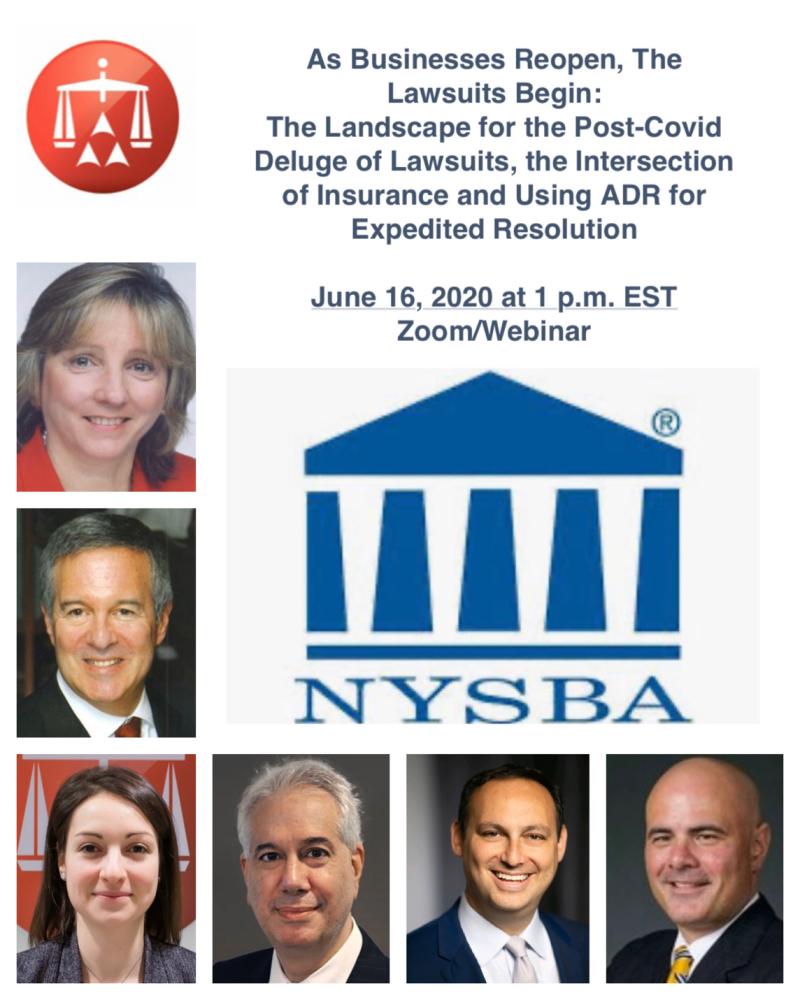 SAVE THE DATE: June 16, 2020 at 1 p.m. EST, a NYSBA Dispute Resolution Section Zoom/Webinar.
As Businesses Reopen, The Lawsuits Begin: The Landscape for the Post-Covid Deluge of Lawsuits, the Intersection of Insurance and Using ADR for Expedited Resolution.
I look forward to moderating this program with an amazing panel consisting of AAA-ICDR Arbitrators Deborah Masucci, Mark Bunim, John Diaconis, Peter A. Halprin, FCIArb, FAiADR, and my AAA-ICDR colleague Svetlana Gitman.
See the following link to register:
Read MoreClient Alert: Virus claims are here: A range of policies may be impacted.
Many U.S. businesses are experiencing large financial losses due to the coronavirus pandemic. Last month, governments imposed severe restrictions and businesses curtailed their customary operations in response to the crisis. The loss of business income due to these events will result in significant first-party property insurance claims. The availability and scope of coverage available to businesses is likely to be disputed between insureds and insurers and litigated for years to come. Policy details and careful analysis will determine the success or failure of these claims.
Read MoreClient Alert: Sweeping Changes to Medicaid Home Care, Effective 10/01/2020
While the Department of Health provided temporary relief to Medicaid recipients and applicants during the COVID-19 pandemic, the New York legislature has enacted new restrictions on Medicaid home care applications that are slated to go into effect on October 1, 2020. These restrictions were recommended by the Governor’s Medicaid Redesign Team in an effort to reduce New York State’s rapidly expanding Medicaid budget. Although applicants who seek Medicaid payments for nursing home care have long been subject to imposition of transfer penalties for gifts made in the five-year (60-month) “look back” period prior to the submission of the application, New York has not previously penalized transfers of assets made by applicants for services in the home. However, as of October 1, 2020, gifts made in the 30-months prior to submission of a Medicaid home care application will be penalized unless qualified as an exempt transfer. Additionally, the legislation authorizes changes to the home care assessment and delivery process.
Read MoreClient Alert: Medicaid Updates
Temporary Easing of Medicaid Documentation Requirements
The COVID-19 pandemic has been a cataclysmic event for our nation’s most vulnerable, particularly the elderly. Nursing homes and assisted living facilities are on lockdown, and home care patients struggle to find and maintain care as the number of available home health aides has dropped precipitously. New Yorkers who rely on the Medicaid program to finance their home care services face all these same challenges, with the added pressures of limited means.
Read MoreClient Alert: COVID-19 Estate Planning Update
With the COVID-19 pandemic currently ravaging New York State and the nation, there has never been a more critical time to review and update your estate planning documents. Yet, until now, the social distancing rules currently in place have made it very difficult, if not impossible, for clients to execute some of the most important estate planning documents (like wills) because applicable law required witnesses to be physically present when these documents were signed. However, just this past Tuesday, April 7, 2020, New York Governor Andrew M. Cuomo issued Executive Order 202.14, which allows for remote witnessing of these crucial estate planning documents via videoconferencing technology. In a previous Executive Order, Governor Cuomo allowed a Notary Public to take an acknowledgment or oath remotely over videoconferencing software as well.
Read MoreCOVID-19 CLIENT ALERT – LANDLORD-TENANT ISSUES
While the Governor has mandated that banks provide homeowners with “forbearance” regarding their home mortgage payments if the homeowner is facing financial hardships due to the COVID-19 pandemic, to date there has not been any corresponding requirement that landlords provide “forbearance” to tenants with respect to their rent obligations. The rights available to tenants may well be determined by two considerations: whether they are residential or commercial tenants; and the language in their leases.
Read MoreCOVID-19 CLIENT ALERT – Summary of the Coronavirus Aid, Relief and Economic Security (CARES) Act
On March 27, President Trump signed the Coronavirus Aid, Relief, and Economic Security (CARES) Act, a stimulus package of unprecedented proportions intended to provide economic relief and assistance to American individuals and businesses impacted by the COVID-19 pandemic.
Read MoreCOVID-19 CLIENT ALERT
The COVID-19 pandemic is causing all New York businesses to face unprecedented uncertainties and challenges in a host of areas central to their operations. The landscape of state and federal laws being passed, and regulations and executive orders being issued, is changing almost daily. We are monitoring these changes in federal and state laws, and are continuing to provide guidance and advice to our clients as they navigate these ever-changing and uncharted waters. Although not comprehensive, below we provide some highlights of important changes that may affect your business.
Read More
Five Coronavirus Legal Issues for Local Government Leaders
By Adam Rodriguez, Esq.
Local governments are on the front lines of the COVID-19 crisis. Here are a few legal updates and issues that local government leaders need to be aware of.
Read More
The Families First Coronavirus Response Act
By Adam Rodriguez, Esq.
COVID-19 issues are unfolding unfold rapidly and the government is taking swift and decisive action to deal with the impact. Employers have to be prepared quickly understand and implement these new policy decisions.
The newly enacted Families First Coronavirus Response Act (“FFCRA”) requires small employers (less than 500 employees) to provide employees with paid sick leave and paid family leave for COVID-19 related reasons. Both changes go into effect April 2, 2020 and will remain in place until the end of 2020.
Read More
Bleakley Platt & Schmidt and Continuing Legal Education
Bleakley Platt & Schmidt, LLP is proud of it’s more than 80-year legacy of providing superior legal counsel to the residents and businesses of Westchester County and Greenwhich, CT. The firm is also dedicated, however, to helping foster the talent of up-and-coming lawyers and to the education of the legal community. For this reason, our attorneys, like partner Frances M. Pantaleo, frequently speak at Continuing Legal Education (CLE) courses – specialized professional education required for attorneys, following admission to the bar.
Ms. Pantaleo, head of the firm’s Elder Law and Special Needs Practice Group, for example, will speak at a CLE entitled “An Introduction to Elder Law and Special Needs Planning,” presented by the Westchester County Bar Association’s Trust & Estates and Elder Law committees, on Thursday, January 16.
Elder law is the area of legal practice providing counsel in matters concerning health care, long-term care planning, estate planning (including preparation of wills, trusts, and advance directives), asset preservation and protection, Medicaid applications, and guardianship. Under Ms. Pantaleo’s leadership, the Elder Law and Special Needs Practice Group works closely with clients’ family advisors, including family offices, financial advisors, CPAs, social workers, and healthcare professionals, in providing such services.
An educator, as well as an attorney, Ms. Pantaleo has taught law at the Benjamin N. Cardozo School of Law in New York City and Pace Law School in White Plains. She previously spoke at the New York State Bar Association’s “Basic Elder Law” CLE in November.
Other Bleakley Platt & Schmidt attorneys who have spoken at CLEs and similar programs include associate Brendan H. Buschman, who gave an overview on special needs estate planning at NYSBA’s “Special Education” CLE in October; associate Daniel P. Buckley, who, in October, presented on Estate Planning with Digital Assets at NYSBA’s “Intermediate Trusts and Estates” CLE, and partner Nancy J. Rudolph, who spoke about the Surrogate’s Court mediation program at the October meeting of the NYSBA Trusts & Estates and Elder Law & Special Needs Sections.
“An Introduction to Elder Law and Special Needs Planning” will be held on Thursday, January 16 from 5:30pm to 8:00pm, in the Ground Floor Conference Room at 2 Westchester Park Drive, White Plains, NY. Registration is required. To register, click here.
Read More
Bleakley Platt & Schmidt’s Frances M. Pantaleo to Speak at WCBA January CLE
Bleakley Platt & Schmidt partner and head of the firm’s Elder Law and Special Needs Practice Group, Frances M. Pantaleo, Esq. will speak at a Continuing Legal Education course entitled “An Introduction to Elder Law and Special Needs Planning,” presented by the Westchester County Bar Association’s Trust & Estates and Elder Law committees, on Thursday, January 16.
Elder law is the area of legal practice providing counsel in matters concerning health care, long-term care planning, estate planning (including preparation of wills, trusts, and advance directives), asset preservation and protection, Medicaid applications, and guardianship. Under Frances Pantaleo’s leadership, the Elder Law and Special Needs Practice Group works closely with clients’ family advisors, including family offices, financial advisors, CPAs, social workers, and healthcare professionals, in providing such services.
Ms. Pantaleo is a member of the National Academy of Elder Law Attorneys (NAELA) and previously served as Chair of the New York State Bar Association’s Elder Law and Special Needs Section. She was recently named Best Lawyers’ 2020 Lawyer of the Year in White Plains for the field of Elder Law. Additionally, the Thomson Reuters publication Super Lawyers Magazine has recognized her as one of the Top 25: 2019 Westchester County Super Lawyers, and the publication has also named her as one of the top 50 Women Lawyers in the Metro Area. She has also been honored with an award from the New York State Bar Association Elder Law & Special Needs Section for her work “in furtherance of the rights of the elderly and persons with disabilities.”
An educator, as well as an attorney, Ms. Pantaleo has taught law at the Benjamin N. Cardozo School of Law in New York City and Pace Law School in White Plains. She previously spoke at the New York State Bar Association’s “Basic Elder Law” CLE in November.
“An Introduction to Elder Law and Special Needs Planning” will be held on Thursday, January 16 from 5:30pm to 8:00pm, in the Ground Floor Conference Room at 2 Westchester Park Drive, White Plains, NY. Registration is required. To register, click here.
Bleakley Platt & Schmidt, LLP is Westchester’s preeminent law firm, with a more than 80-year legacy of providing superior legal counsel to the residents and businesses of Westchester County and Greenwhich, CT. To learn more about the firm’s services, visit https://www.bpslaw.com/, or contact its offices at (914) 949-2700. Click here to send an email and inquire about Frances Pantaleo, Esq’s team and practice areas.
Read More
The First Three Westchester County Executives

Both Judge Bleakley and Judge Hopkins were former BPS attorneys.
Click here for an accessible text only version of the flyer shown above.


Bleakley Platt & Schmidt’s John McGowan Begins First Term on County Legislature
Bleakley Platt & Schmidt, LLP associate John W. McGowan, Esq, was recently sworn in as Rockland County’s District 15 Legislator, joining the County Legislature, comprised of 17 representatives from throughout Rockland.
A lifelong resident of Rockland County, McGowan’s victory in District 15 was his first run for elected office and is the culmination of an extensive record of public service and community involvement. As an attorney at Bleakley Platt & Schmidt, McGowan, who is admitted to practice in both New York State and federal courts, is a member of the Litigation Practice Group, where he specializes in general liability defense, construction law, and criminal defense. He is a former Senior Assistant District Attorney of the Rockland County District Attorney’s Office, where he was assigned to the Special Victims’ Unit.
Appointed by Rockland County Executive Ed Day in 2018, McGowan is a board member of the Rockland County Solid Waste Management Authority. He is also president of the Rockland Ancient Order of Hibernians, as well a member of the Rockland Friendly Sons of St. Patrick, Pearl River Elks Lodge 2041, St. Dominic Knights of Columbus, and a volunteer with the Lourdes Kids of Rockland and Pearl River American Legion, Post 329. He is an adjunct professor at St. Thomas Aquinas College and a faculty instructor with the Orangetown Police Youth Court.
McGowan began his four-year term on January 2, 2020, replacing outgoing District 15 legislator, Patrick Moroney.
Bleakley Platt & Schmidt, LLP is Westchester’s preeminent law firm, with a more than 80-year legacy of providing superior legal counsel to the residents and businesses of Westchester County and Greenwhich, CT. To learn more about the firm’s services, visit https://www.bpslaw.com/, or contact its offices at (914) 949-2700. To learn more about John W. McGowan, his practice areas, and services offered, email him at jmcgowan@bpslaw.com.
Read MoreThe Need for an Elder Lawyer While Caring for a Loved One
Bleakley Platt & Schmidt partner Frances M. Pantaleo, Esq. and her team of elder law specialists understand that caring for an aging family member is a responsibility that tests the endurance of even the most devoted relatives. Fortunate families might find their loved one a room and specialized care at a retirement home or memory unit, but such a move brings its own stressors, like Medicare/Medicaid requirements and policies, on top of the inherent emotional strain. Few are prepared to navigate the intricacies of the system. Fortunately, Ms. Pantaleo leads the firm’s Elder Law and Special Needs Practice Group, dedicated to addressing the needs of the elderly, the differently abled, and their families.
A member of the National Academy of Elder Law Attorneys (NAELA) and Co-Chair of the New York State Bar Association’s Committee on the Elderly and Disabled, Frances Pantaleo, Esq. was recently named Best Lawyers’ 2020 Lawyer of the Year in White Plains for the field of Elder Law. Additionally, the Thomson Reuters publication Super Lawyers Magazine has recognized her as one of the Top 25: 2019 Westchester County Super Lawyers, and the publication has also named her as one of the top 50 Women Lawyers in the Metro Area. She has also been honored with an award from the New York State Bar Association Elder Law & Special Needs Section for her work “in furtherance of the rights of the elderly and persons with disabilities.” An educator, as well as an attorney, Ms. Pantaleo has taught law at the Benjamin N. Cardozo School of Law in New York City and Pace Law School in White Plains.
Under Frances Pantaleo’s leadership, the Elder Law and Special Needs Practice Group works closely with clients’ family advisors, including family offices, financial advisors, CPAs, social workers, and healthcare professionals, providing counsel in the areas of health care, long-term care planning, estate planning (including preparation of wills, trusts, and advance directives), asset preservation and protection, Medicaid applications, and guardianship.
If you or a loved on are in need of elder law services, don’t wait to find out how Bleakley Platt & Schmidt can help. Contact Frances Pantaleo, Esq. to begin fighting for the care you need and the security your family deserves.
Read More